Unclear AI Strategy
Organizations may pursue disconnected AI tools without clear priorities, business outcomes, ownership, or implementation plans.
SingTone Technologies helps businesses identify practical opportunities for artificial intelligence, automate repetitive work, improve customer and employee experiences, strengthen decision-making, and adopt AI responsibly through strategy, implementation, integration, governance, training, and ongoing support.

Business Challenges
Businesses want to use AI to improve efficiency and competitiveness, but many struggle to identify valuable use cases, prepare data and processes, integrate solutions, manage risk, protect sensitive information, and ensure employees understand how AI should be used.
Organizations may pursue disconnected AI tools without clear priorities, business outcomes, ownership, or implementation plans.
Employees spend significant time on data entry, document handling, status updates, customer responses, and recurring administrative tasks.
AI initiatives depend on accessible, accurate, organized, secure, and appropriately governed business data.
AI tools often need to connect with applications, databases, websites, customer platforms, and operational workflows.
Uncontrolled AI use can expose confidential information, customer data, intellectual property, credentials, and internal processes.
Businesses need clear policies, approval processes, human oversight, documentation, monitoring, and responsibility for AI-supported decisions.
Teams may resist new tools or use them inconsistently without role-based guidance, training, and practical support.
Organizations need meaningful measures for productivity, cost savings, quality, customer experience, adoption, and return on investment.
What We Deliver
SingTone combines business analysis, application development, data services, cybersecurity, workflow automation, governance, quality management, and training to help organizations implement AI in ways that support real operational needs.
Define practical AI priorities, business outcomes, governance requirements, implementation phases, resources, and measures of success.
Evaluate organizational readiness across strategy, data, processes, technology, security, governance, workforce capability, and operational support.
Automate repetitive activities, approvals, routing, notifications, data movement, task assignments, and recurring operational workflows.
Create customer-facing and internal assistants that help answer questions, guide users, retrieve approved information, and support service delivery.
Use automation and AI to classify documents, extract information, validate content, route work, and reduce manual document handling.
Apply generative AI to approved business use cases such as drafting, summarization, knowledge retrieval, content support, and internal productivity.
Enhance reporting, trend analysis, forecasting, anomaly identification, and decision support through AI-assisted analytics.
Connect AI capabilities with websites, applications, databases, customer platforms, productivity tools, APIs, and operational systems.
Establish policies, controls, ownership, approval processes, acceptable-use standards, human oversight, documentation, and monitoring.
Protect business information and reduce risk through secure configurations, access controls, data handling requirements, logging, and vendor reviews.
Validate functionality, accuracy, reliability, security, usability, accessibility, workflows, and human-review requirements before deployment.
Measure AI and automation outcomes using operational, financial, quality, adoption, customer, and productivity indicators.
Prepare executives, managers, technical teams, and employees to use AI tools responsibly, effectively, and consistently.
Maintain AI-enabled workflows through monitoring, issue resolution, updates, model or vendor changes, documentation, and continuous improvement.
Our Approach
We use a structured approach to identify valuable use cases, assess readiness, establish governance, design secure solutions, validate performance, support adoption, and improve AI-enabled operations over time.
Engage stakeholders to understand business objectives, operational challenges, customer needs, data sources, technology constraints, and desired outcomes.
Evaluate organizational, process, data, technology, security, governance, workforce, and operational readiness for AI and automation.
Compare potential use cases based on business value, feasibility, risk, data readiness, implementation effort, and expected return.
Define ownership, acceptable use, approval requirements, human oversight, security controls, documentation, monitoring, and accountability.
Develop future-state workflows, solution architecture, integration requirements, business rules, user experiences, controls, and performance measures.
Configure or develop AI assistants, automated workflows, integrations, document processing, analytics, and supporting business applications.
Test functionality, outputs, security, privacy, accessibility, usability, data handling, workflow performance, and human-review requirements.
Monitor performance, evaluate adoption, address issues, refine workflows, update governance, measure value, and expand successful capabilities.
Why SingTone
SingTone combines business analysis, application development, data services, cybersecurity, quality management, workflow automation, technical writing, and training to help organizations adopt AI with purpose and control.
Use cases are prioritized around measurable business needs rather than adopting technology without a clear operational purpose.
AI and automation reduce repetitive work, streamline workflows, accelerate processing, and improve employee productivity.
Intelligent assistants and automated workflows can provide faster responses, guided service, and more consistent engagement.
AI-assisted analytics, forecasting, summarization, and knowledge retrieval help teams evaluate information more efficiently.
Security, privacy, governance, approved use cases, human oversight, and testing reduce avoidable operational and reputational risk.
Defined ownership, approval authorities, documentation, monitoring, escalation, and review support responsible AI use.
AI capabilities can be connected with applications, databases, websites, customer systems, and existing workflows.
Role-based training, policies, guidance, documentation, and support help employees use AI consistently and responsibly.
Phased roadmaps allow businesses to begin with high-value opportunities and expand based on results, readiness, and priorities.
Our certified quality management system supports documented requirements, controlled implementation, validation, corrective action, and continuous improvement.
Related Experience
Representative engagements demonstrating business process automation, application development, data integration, AI readiness, governance, cybersecurity, technical documentation, training, and operational modernization.

SingTone served as a subcontractor to JYG Innovations supporting the Air Force Life Cycle Management Center (AFLCMC) by providing software sustainment, application development, systems integration, testing, configuration management, technical documentation, and secure data exchange services for the Contractor Supported Weapon Systems Data Exchange (CSWS DE) system.

SingTone provided advanced search engine optimization (SEO) services for Healthcare Training Solutions, Inc., improving the organization's online visibility, technical search performance, and organic search rankings to attract prospective students and healthcare professionals.
SingTone partnered with ECPI University to mentor students during the development of a WordPress website for Mid-Atlantic Growth LLC and continues to provide managed hosting, technical support, and ongoing website maintenance.
Related Insights
Explore insights related to responsible AI, business automation, generative AI, workflow modernization, AI governance, security, data readiness, customer experience, and operational efficiency.

Digital transformation can improve SEO by creating faster websites, better user experiences, stronger content, connected data, and scalable systems that help organizations attract and convert more organic traffic.
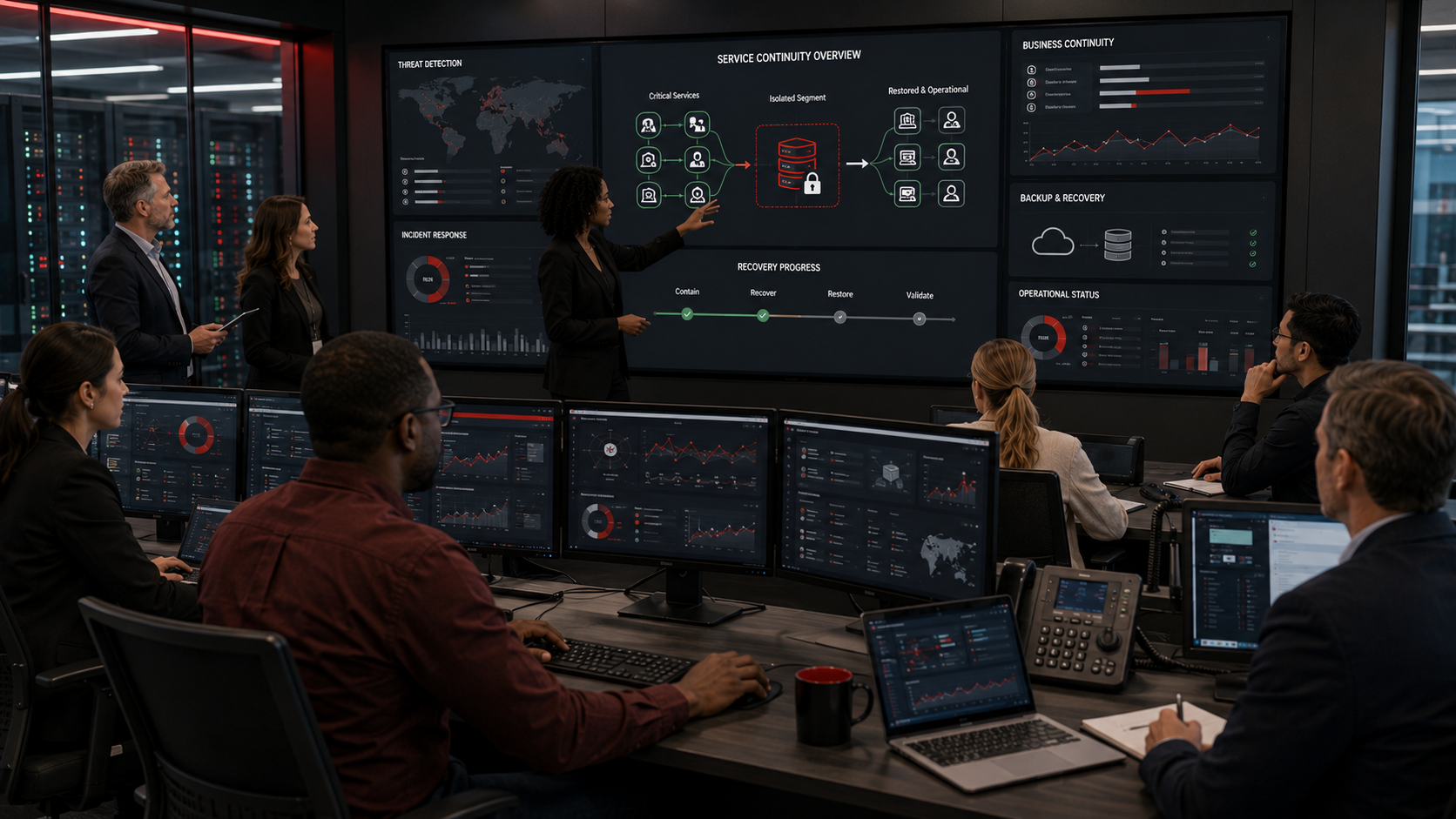
Cybersecurity controls can reduce risk, but no organization can prevent every incident. Cyber resilience helps organizations maintain critical operations, respond effectively, and recover faster when defenses fail.

AI helps marketers analyze customer data, personalize experiences, automate routine work, and improve campaign decisions. Responsible implementation can strengthen engagement without sacrificing accuracy, privacy, or human judgment.
Frequently Asked Questions
Common questions regarding AI strategy, automation, chatbots, generative AI, governance, security, integration, testing, training, implementation, and ongoing support.
Connect with SingTone regarding AI strategy, readiness assessments, business automation, intelligent assistants, generative AI, system integration, governance, security, training, or ongoing support.